
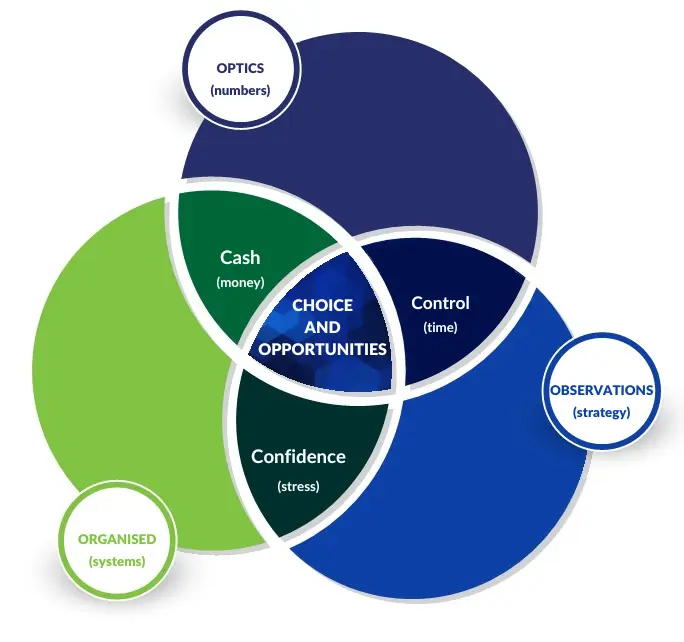
The Three Motivators that shape every business
Every business owner starts with a dream.
A dream to create something meaningful.
A dream to enjoy more freedom.
A dream to build a business that supports the life they want to live.
But as any business owner knows, the reality can look very different.
Instead of freedom, you find yourself working longer hours.
Instead of financial security, cashflow becomes a constant concern.
Instead of confidence, every decision feels heavier than it should.
If you’ve ever experienced this, you’re not alone.
After working with hundreds of small business owners over the years, I’ve noticed something interesting.
Regardless of the industry, size or stage of the business, the same three themes continually appear.
Business owners want:
- Enough Cash to feel financially secure.
- Enough Control to enjoy the business rather than being controlled by it.
- Enough Confidence to make decisions without constant stress.
These are what I call the Three Motivators.
They sit at the heart of The Thriving Blueprint, my framework for helping businesses move from struggling and surviving to living and thriving.
Understanding these three motivators changes the way you look at business.
Instead of chasing isolated goals, you begin building a business that creates lasting success.
Success Isn’t Just About Profit
One of the biggest myths in business is that success is measured by revenue or profit alone.
While financial performance is important, it tells only part of the story.
Imagine two businesses generating the same annual profit.
The first owner works 70-hour weeks, constantly worries about cashflow, and can’t take a holiday without checking emails every hour.
The second owner works reasonable hours, has predictable cashflow, and confidently delegates work to a capable team.
Financially they may appear similar.
In reality, they are experiencing completely different businesses.
The difference is found in Cash, Control and Confidence.
These three motivators determine how your business feels as much as how it performs.
Why These Three Motivators Matter
Many business owners believe they have dozens of goals.
- Grow revenue.
- Hire staff.
- Improve marketing.
- Reduce tax.
- Increase profit.
- Take holidays.
- Work fewer hours.
- Sleep better.
When you look closely, however, almost every goal connects back to one of three underlying motivators.
You want more revenue because it improves Cash.
You want better systems because they improve Control.
You want better information because it builds Confidence.
Once you recognise this, decision-making becomes much simpler.
Rather than asking, “What should I do next?”, you begin asking, “Which motivator needs the most attention?”
That simple shift creates clarity.
Cash: Creating Financial Security
Cash is the motivator most people think about first.
Without cash, businesses cannot survive.
But cash is about far more than having money in the bank.
It represents options.
When cash is healthy, you have choices.
You can invest in new equipment.
You can employ the right people.
You can market your business.
You can survive unexpected setbacks.
Healthy cash creates confidence because it reduces uncertainty.
Why Profit Doesn’t Always Equal Cash
One of the biggest misunderstandings in business is assuming profitable businesses always have money.
Many profitable businesses struggle with cashflow.
Why?
Because profit is an accounting measure.
Cash is reality.
You may have invoices waiting to be paid.
Stock sitting on shelves.
Loan repayments due.
Equipment purchases planned.
On paper everything looks healthy.
In the bank account, things feel very different.
Understanding this difference is one of the most important financial lessons any business owner can learn.
Signs Cash Needs Attention
Your Cash motivator may be under pressure if you regularly:
- Worry about paying bills.
- Delay paying yourself.
- Depend on overdrafts or credit cards.
- Avoid checking your bank balance.
- Feel anxious before payroll.
None of these are simply financial issues.
They affect every decision you make.
Control: Taking Back Your Time
When I ask business owners why they started their business, one answer appears again and again.
“I wanted more freedom.”
Ironically, many end up with less.
Their business depends entirely on them.
Nothing happens unless they approve it.
Every problem lands on their desk.
Every interruption demands attention.
This is a Control problem.
Control Is More Than Time Management
Many people think control means better scheduling.
It goes much deeper.
Control is about creating a business that operates intentionally rather than reactively.
It’s knowing:
- what needs your attention,
- what can be delegated,
- what can be automated,
- and what shouldn’t be done at all.
Businesses with strong control don’t necessarily work fewer hours.
They work on the right things.
Signs Control Needs Attention
You may need to improve Control if:
- you rarely finish your to-do list,
- holidays feel impossible,
- staff constantly ask questions,
- you are the bottleneck,
- every day feels reactive.
Control is created through systems, planning and clear decision-making.
It cannot be created by simply working harder.
Confidence: The Hidden Motivator
Confidence is often overlooked because it feels less tangible than money or time.
Yet it influences every decision you make.
Business confidence is not about personality.
It isn’t about pretending to know everything.
Confidence comes from clarity.
The more clearly you understand your business, the more confidently you lead it.
Confidence Reduces Stress
Many business owners describe stress as part of business ownership.
Some stress is inevitable.
Constant stress is not.
Most business stress comes from uncertainty.
Questions such as:
- Are we making enough money?
- Can we afford to employ someone?
- Should we increase prices?
- Is now the right time to invest?
Without information, every decision feels risky.
With clarity, those same decisions become manageable.
Signs Confidence Needs Attention
You may need to improve Confidence if:
- you second-guess decisions,
- you avoid financial reports,
- you delay making changes,
- you constantly seek reassurance,
- you feel overwhelmed by uncertainty.
Confidence grows as understanding grows.
Why The Three Motivators Are Connected
Cash, Control and Confidence never operate independently.
Imagine improving cashflow.
Immediately you feel less pressure.
Stress reduces.
Confidence improves.
Or imagine implementing better systems.
You save time.
Control increases.
Confidence grows because the business feels more organised.
Every improvement creates a ripple effect.
This is why The Thriving Blueprint treats these motivators as an integrated system rather than separate goals.
The healthiest businesses improve all three together.
The Four Stages of Business Growth
Within The Thriving Blueprint, businesses typically move through four stages.
Struggling
Cash is tight.
Control feels impossible.
Confidence is low.
Business owners spend most of their time reacting.
Surviving
The business continues operating but progress feels slow.
Cash improves slightly.
Control remains limited.
Confidence fluctuates.
Many businesses remain here for years.
Living
The business becomes more stable.
Cash becomes predictable.
Control improves.
Confidence grows.
Business ownership becomes enjoyable again.
Thriving
The business creates opportunities rather than stress.
Cash supports growth.
Time is intentional.
Confidence drives better decisions.
Thriving is not perfection.
It is the result of consistently improving the right things.
While the Three Motivators describe what every business owner is striving for, sustainable improvement comes from strengthening the Three Drivers that sit behind them.
How Do You Improve Cash, Control and Confidence?
This is where the Three Drivers become essential.
Optics (Numbers)
Better numbers create:
- stronger Cash,
- greater Control.
Understanding your numbers helps you make better decisions earlier.
Organised (Systems)
Better systems improve:
- Cash,
- Confidence.
Simple processes reduce wasted time and unnecessary stress.
Observations (Strategy)
Strategic thinking improves:
- Control,
- Confidence.
Stepping back allows you to identify opportunities before they become obvious.
Together these drivers strengthen all three motivators.
Which Motivator Needs Your Attention?
Every business is different.
For some businesses, Cash is the greatest challenge.
For others, the biggest issue is Control.
Others appear financially successful but quietly struggle with Confidence.
The important thing is recognising where your greatest opportunity lies today.
Small improvements made consistently create remarkable change over time.
Start With Awareness
One of the biggest turning points for any business owner is recognising where they are today.
Not where they hope they are.
Not where they used to be.
Where they are now.
Awareness creates clarity.
Clarity creates action.
Action creates progress.
This is why the first step in The Thriving Blueprint is understanding your current position.
Only then can you build the right plan for moving forward.
Your Next Step
If you’re ready to create a business with greater Cash, greater Control and greater Confidence, start by understanding where your business stands today.
Take the Business Health Quiz to discover whether your business is Struggling, Surviving, Living or Thriving, and identify the next steps to move forward.
Because thriving isn’t about luck.
It’s about building a business that gives you the freedom, security and confidence you dreamed of when you first started.
Dream. Plan. Thrive.
Explore The Thriving Blueprint Course
Continue Reading
If you enjoyed this article, you may also find these resources helpful:
The Thriving Blueprint:
- The Thriving Blueprint: A Framework for Business Growth
- The 3 Motivators Every Business Owner Needs
- The 3 Drivers of a Thriving Business
- The Four Stages Every Business Owner Experiences | From Struggling to Thriving
Cashflow & Profit: