
Every business owner wants a thriving business.
They want healthy cashflow.
They want more control over their time.
They want confidence in their decisions.
They want a business that supports the life they are trying to build.
Yet many business owners find themselves stuck.
They work hard.
They solve problems.
They put in long hours.
But despite all that effort, progress feels frustratingly slow.
The reason is simple.
Most business owners focus on outcomes without understanding the drivers that create those outcomes.
They focus on increasing revenue without improving visibility.
They focus on reducing stress without improving systems.
They focus on growth without creating the clarity required to make better decisions.
In my previous article, I introduced the Three Motivators Every Business Owner Needs: Cash, Control and Confidence.
These motivators explain what drives business owners and what ultimately determines their quality of life.
But if Cash, Control and Confidence are the outcomes we want, what creates them?
The answer lies in three critical drivers.
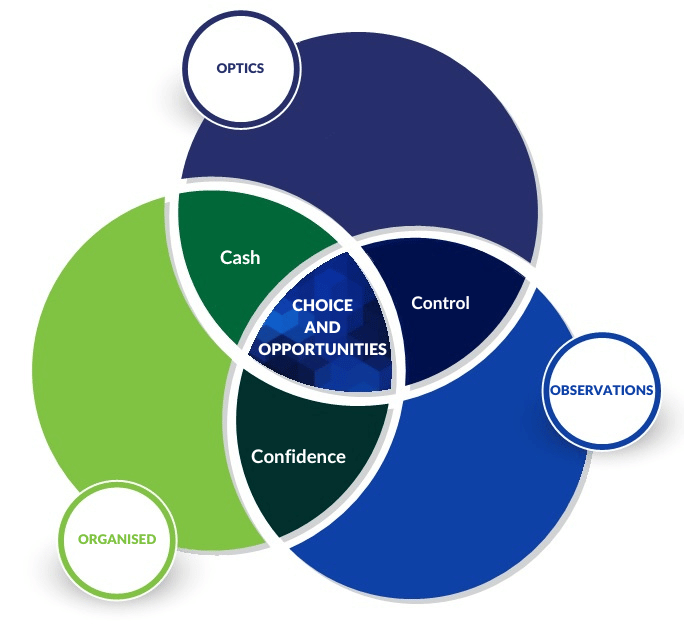
Optics. Organised. Observations.
These are the three drivers at the heart of The Thriving Blueprint.
These drivers don’t exist in isolation.
They are one part of The Thriving Blueprint, a complete business growth framework that explains how the Three Motivators, Three Drivers and Four Stages of Growth work together to create a thriving business.
Together, they create the momentum that moves businesses from struggling and surviving to living and thriving.
Why Drivers Matter
Imagine you’re driving a car.
The dashboard shows your speed, fuel level, and warning lights.
Those indicators tell you what is happening.
But they don’t make the car move.
The engine is what creates movement.
In business, Cash, Control and Confidence are like the dashboard indicators.
They tell you how healthy your business is.
The drivers are the engine.
They create the conditions that improve those outcomes.
Many business owners spend years trying to improve results without addressing the underlying drivers.
They become frustrated because they are treating symptoms rather than causes.
For example:
- Poor cashflow may actually be a visibility problem.
- Lack of time may actually be a systems problem.
- Stress may actually be a clarity problem.
When you improve the drivers, the outcomes improve naturally.
This is why thriving businesses often seem easier to run.
In The Thriving Blueprint Framework, these foundations are built by strengthening the three drivers before focusing on growth outcomes.
Understanding The Relationship Between Drivers and Motivators
The Three Drivers and Three Motivators are closely connected.
Optics improves:
- Cash
- Control
Organised improves:
- Cash
- Confidence
Observations improves:
- Control
- Confidence
As each driver strengthens, the corresponding motivators improve.
The result is a healthier, stronger, and more resilient business.
Let’s explore each driver in more detail.
Driver 1: Optics (Numbers)
You Can’t Improve What You Can’t See
Imagine trying to drive a car at night with no headlights.
You may continue moving forward, but eventually you’ll hit something.
Many businesses operate this way.
Business owners are making decisions every day without having a clear picture of what is happening inside their business.
They know money is coming in.
They know bills are being paid.
But they don’t have visibility over the numbers that truly matter.
Without visibility, decisions become guesses.
And guessing is expensive.
Optics is about creating visibility.
It is about understanding the story hidden inside your numbers.
Why Most Business Owners Struggle With Numbers
Many business owners didn’t start their business because they love accounting.
They started because they have expertise, passion, or a vision.
As a result, financial reports often feel intimidating.
Profit and Loss reports are generated but never reviewed.
Budgets are created once and forgotten.
Cashflow is checked only when there is a problem.
The unfortunate reality is that businesses often discover financial problems long after they have started.
By the time cashflow becomes an issue, the warning signs have usually existed for months.
Good Optics helps you identify problems earlier.
It gives you time to respond before challenges become crises.
The Power of Visibility
When business owners understand their numbers, several things happen.
They become proactive instead of reactive.
They identify trends earlier.
They make better pricing decisions.
They allocate resources more effectively.
They gain confidence because they are making decisions based on facts rather than assumptions.
Visibility creates control.
And control creates confidence.
Questions Every Business Owner Should Be Able To Answer
A business with strong Optics can answer questions such as:
- Which products or services are most profitable?
- Where is cash being spent?
- What does the next three months of cashflow look like?
- What revenue is required to achieve business goals?
- Which areas of the business are improving or declining?
The answers to these questions create clarity.
And clarity is one of the most valuable assets any business owner can possess.
Driver 2: Organised (Systems)
Chaos Is More Expensive Than Most Business Owners Realise
Every business develops systems.
The question is whether those systems are intentional or accidental.
In many businesses, processes evolve over time.
One person creates a spreadsheet.
Another develops their own method.
Information is stored in different locations.
Tasks are repeated because nobody is sure whether they were completed.
Over time, complexity grows.
What started as a simple business becomes increasingly difficult to manage.
This hidden complexity creates friction.
And friction costs money.
What Organised Really Means
Being organised is not about colour-coded folders or perfectly labelled files.
It is about creating systems that make work easier.
Organised businesses:
- Collect information efficiently
- Store information consistently
- Share information effectively
- Reduce duplication
- Create repeatable processes
The goal is not perfection.
The goal is simplicity.
Every unnecessary step removed from a process saves time, energy, and money.
Why Systems Improve Confidence
Many people associate systems with productivity.
But systems also have a powerful impact on confidence.
When processes are documented and repeatable:
- Staff know what is expected
- Information is easier to find
- Mistakes are reduced
- Decisions become simpler
The business owner no longer carries every responsibility in their head.
Mental load decreases.
Stress decreases.
Confidence increases.
The Hidden Cost Of Poor Systems
Poor systems rarely appear as a line item in financial reports.
Yet they can be incredibly expensive.
Poor systems create:
- Rework
- Delays
- Errors
- Frustration
- Lost opportunities
Many businesses believe they need more people when what they actually need are better processes.
Often the fastest way to improve profitability is not increasing revenue.
It’s reducing friction.
Building A Business That Doesn’t Depend On You
One of the greatest benefits of becoming organised is creating independence.
Businesses that depend entirely on the owner are difficult to scale.
Every decision becomes a bottleneck.
Every absence creates disruption.
Strong systems allow businesses to operate consistently regardless of who is performing the work.
This creates both freedom and resilience.
And that freedom contributes directly to thriving.
Driver 3: Observations (Strategy)
The Most Overlooked Driver
Of the three drivers, Observations is often the most neglected.
Not because it isn’t important.
But because it rarely feels urgent.
Most business owners spend their days responding to immediate demands.
Customer enquiries.
Staff issues.
Operational problems.
Financial pressures.
As a result, very little time is left for observation.
Yet observation is often where the biggest opportunities exist.
The Difference Between Working In And On The Business
A concept often discussed in business is the difference between working in the business and working on the business.
Working in the business involves day-to-day activities.
Serving customers.
Managing staff.
Completing operational tasks.
Working on the business involves stepping back and examining the bigger picture.
Observations sits firmly in this category.
It is the discipline of creating space to think.
Why Observation Creates Better Decisions
Every business generates information.
Customer feedback.
Financial results.
Market trends.
Operational challenges.
Strategic opportunities.
The problem is not a lack of information.
The problem is a lack of time to interpret it.
Observation transforms information into insight.
Insight leads to better decisions.
Better decisions lead to better outcomes.
What Successful Business Owners Notice
Thriving business owners develop a habit of observation.
They notice:
- Emerging opportunities
- Changing customer needs
- Operational bottlenecks
- Market shifts
- Financial trends
They identify issues before they become problems.
They identify opportunities before competitors do.
They see patterns others miss.
This ability is not luck.
It is the result of creating space for reflection.
Observation Creates Control
One of the greatest sources of stress in business is uncertainty.
When business owners don’t know what is coming next, they feel reactive.
Observation helps reduce uncertainty.
It creates a greater sense of control.
And when control increases, confidence follows.
How The Drivers Work Together
The real power of The Thriving Blueprint emerges when all three drivers work together with the three motivators. Rather than solving isolated problems, the framework creates sustainable improvement across every area of your business.
Optics provides visibility.
Organised creates efficiency.
Observations creates direction.
Together they create a business that is easier to manage, easier to grow, and easier to enjoy.
When one driver is missing, progress slows.
When all three drivers are strong, momentum accelerates.
This is why thriving businesses rarely excel in only one area.
They develop capability across all three.
The Path From Surviving To Thriving
Many business owners assume thriving is achieved through a single breakthrough.
A major client.
A new product.
A surge in revenue.
In reality, thriving is usually the result of consistent improvements made over time.
Better visibility.
Better systems.
Better decisions.
These small improvements compound.
They improve Cash.
They improve Control.
They improve Confidence.
And over time they move businesses through the stages of growth:
- Struggling
- Surviving
- Living
- Thriving
Your Next Step
If you want to improve your business, don’t start by asking what outcome you want.
Start by asking which driver needs attention.
Do you need better visibility into your numbers?
Do you need stronger systems and processes?
Do you need more time to step back and think strategically?
The answer will often reveal your greatest opportunity for growth.
Because thriving businesses are not built by accident.
They are built through intentional improvements in the areas that matter most.
Optics.
Organised.
Observations.
Master these three drivers and you create the foundation for greater Cash, greater Control, and greater Confidence.
And when those motivators improve, thriving becomes possible.
Not just for your business.
But for the life your business is helping you create.
Learn more about The Thriving Blueprint Course
Continue Reading
If you enjoyed this article, you may also find these resources helpful: