

Why More Hours Aren’t the Answer
Most people don’t start a business because they dream of working sixty-hour weeks.
They don’t imagine answering emails late into the evening, spending weekends catching up on paperwork, or lying awake at night thinking about everything that still needs to be done.
Yet for many business owners, that’s exactly what happens.
The business that was meant to create freedom gradually begins demanding more and more of their time.
The days become a blur of phone calls, customer enquiries, urgent requests and unexpected problems.
Every interruption feels important.
Every decision lands on your desk.
Every challenge seems to require your attention.
Before long, you’re not running the business.
The business is running you.
If that sounds familiar, you’re certainly not alone.
It’s one of the most common conversations I have with business owners.
They tell me they’re exhausted.
They’re busy every day, yet they never seem to get ahead.
They feel guilty taking a day off because they know the work will still be there when they return.
Many haven’t had a proper holiday in years because they don’t believe the business can function without them.
The strange thing is that most of them don’t need better time management.
They need a business that doesn’t depend on them for every decision.
That’s an important distinction.
The Biggest Myth About Time Management
When business owners feel overwhelmed, the advice they often receive is surprisingly predictable.
Buy a better diary.
Download another productivity app.
Colour-code your calendar.
Wake up earlier.
Create a longer to-do list.
While these strategies may help organise your day, they rarely solve the underlying problem.
Because time management isn’t usually the issue.
Business design is.
If your business depends on you to answer every question, solve every problem and approve every decision, no productivity system will ever create enough hours in the day.
You’ll simply become more efficient at staying overwhelmed.
Real control doesn’t come from managing your time more effectively.
It comes from building a business that operates effectively whether you’re present or not.
That shift in thinking changes everything.
What Does “Control” Really Mean?
When people hear the word control, they often imagine having complete control over every part of their business.
But that’s not realistic.
Markets change.
Customers change.
Technology changes.
Unexpected challenges will always arise.
Within The Thriving Blueprint, Control has a different meaning.
Control is the ability to make intentional decisions instead of constantly reacting to whatever happens next.
It’s having confidence that your business can continue operating because you’ve built strong systems, clear processes and good habits.
Control means knowing what’s happening in your business without needing to be involved in everything.
It means taking holidays without constantly checking your phone.
It means trusting your team to make decisions.
It means spending more time planning the future instead of constantly putting out fires.
Control isn’t about perfection.
It’s about creating freedom.
Why Control Matters
Control is one of the three key motivators within The Thriving Blueprint, alongside Cash and Confidence.
The three are closely connected.
When you lack control over your time, it often affects your cashflow.
You spend your days reacting instead of improving your business.
You postpone strategic decisions because you’re too busy dealing with today’s problems.
You delay reviewing your pricing, refining your systems or planning for growth because there simply isn’t enough time.
Eventually, that also affects your confidence.
You begin questioning whether you’re making the right decisions.
You feel like you’re constantly behind.
The longer this continues, the harder it becomes to step back and change direction.
That’s why creating greater control isn’t just about getting your evenings back.
It’s about creating the space to become the leader your business needs.
Helen’s Insight
One of the biggest mindset shifts I see in business owners is when they stop asking,
“How can I fit more into my day?”
and start asking,
“Why does my business need me to do all of this?”
Those are two very different questions.
The first looks for ways to work harder.
The second begins redesigning the business.
And that’s where lasting change begins.
How Do Business Owners Lose Control?
It rarely happens overnight.
Most businesses don’t wake up one morning in chaos.
Instead, control is lost through hundreds of small decisions.
You answer one email because it’s quicker than explaining it to someone else.
You take on one extra responsibility because you’re the only one who knows how.
You postpone documenting a process because you’re too busy.
You decide not to employ help because “things will settle down next month.”
You continue saying yes to every customer request because you don’t want to disappoint anyone.
Individually, these decisions seem harmless.
Collectively, they create a business that revolves around one person.
You.
Before long, you’re wearing every hat.
Sales.
Customer service.
Marketing.
Administration.
Bookkeeping.
Operations.
Problem solving.
Leadership.
The business becomes increasingly dependent on your knowledge, your experience and your availability.
And that’s not control.
That’s dependence.
Looking Ahead
The good news is that this isn’t permanent.
Just as control is lost through a series of small decisions, it can be regained through a series of intentional ones.
In the next section, we’ll explore the biggest reasons business owners lose control of their time—and why solving those problems starts with changing the way your business operates, not simply the way you organise your calendar.
The Seven Biggest Reasons Business Owners Lose Control
If you’ve ever finished a day wondering what you actually achieved, you’re not alone.
Many business owners are incredibly busy, yet feel like they’re making very little progress.
The reason isn’t usually a lack of effort.
It’s that too much of their time is spent reacting rather than leading.
Over the years, I’ve found that most business owners lose control for the same handful of reasons.
The encouraging news is that each one can be improved.
1. Doing Everything Yourself
This is by far the biggest reason business owners become overwhelmed.
In the early days of a business, doing everything yourself makes sense.
You’re trying to keep costs down.
You know the business better than anyone else.
And often, you’re simply doing what needs to be done.
The problem is that many businesses never move beyond this stage.
Years later, the owner is still:
- answering every phone call
- approving every invoice
- solving every customer problem
- ordering supplies
- chasing unpaid accounts
- fixing mistakes
- making every important decision
It becomes normal.
But it isn’t sustainable.
The more responsibilities you keep, the less time you have to improve the business itself.
Eventually, you’re working harder just to maintain the business instead of growing it.
2. Poor or Non-Existent Systems
Have you ever answered the same question five times in one week?
Or shown a team member how to complete the same task over and over again?
That’s not a people problem.
It’s a systems problem.
Businesses without documented systems depend on memory.
And memory isn’t scalable.
Every task requires another conversation.
Another interruption.
Another explanation.
Strong systems reduce decisions.
They create consistency.
Most importantly, they allow work to happen without the business owner being involved in every step.
Good systems don’t replace people.
They support people.
Helen’s Insight
One of the biggest breakthroughs I see is when business owners realise they aren’t paid for being busy.
They’re paid for creating value.
Every hour spent repeating the same task is an hour that could have been invested in improving the business instead.
3. Constant Interruptions
Phone calls.
Emails.
Text messages.
Staff questions.
Customer requests.
Social media notifications.
Every interruption feels small.
Together, they can consume hours every day.
The real cost isn’t the interruption itself.
It’s the time it takes to refocus afterwards.
When your attention is constantly being pulled in different directions, even simple tasks take longer to complete.
Business owners often believe they’re multitasking.
In reality, they’re continuously switching between priorities.
That constant switching creates fatigue.
4. Saying Yes to Everything
Most business owners genuinely want to help people.
It’s one of the reasons they started their business.
But saying yes to everything comes at a cost.
Every additional service.
Every last-minute request.
Every favour.
Every exception.
Each one adds complexity.
Over time, your business becomes more difficult to manage because you’ve created dozens of different ways of doing the same thing.
Thriving businesses understand that saying no to the wrong opportunities creates space to say yes to the right ones.
5. Delegating Tasks Instead of Responsibility
Many owners believe they’ve delegated because someone else is doing the work.
But then they:
- check every email
- review every document
- answer every question
- approve every decision
That’s not delegation.
That’s supervision.
True delegation isn’t about handing someone a task.
It’s about giving them the knowledge, authority and confidence to complete it successfully.
Delegation should reduce your workload—not simply rearrange it.
6. Spending Too Much Time Working In the Business
This is one of the biggest differences between businesses that survive and businesses that thrive.
Working in your business means delivering products or services, solving daily problems and keeping operations running.
Working on your business means improving systems, reviewing performance, planning for growth and making strategic decisions.
Both are important.
But many owners spend almost all of their time in the first category.
The result?
The business continues operating exactly as it did yesterday.
Nothing improves because no one has time to improve it.
One of the greatest gifts you can give your future business is regularly stepping away from today’s work to build a better business for tomorrow.
7. Never Stopping to Observe
The final reason business owners lose control is surprisingly simple.
They never stop.
Every day becomes another race to complete today’s tasks.
There is little time to reflect.
Little time to analyse.
Little time to ask:
“Is there a better way?”
Within The Thriving Blueprint, one of the Three Drivers is Observations.
Observation creates improvement.
It allows you to notice patterns.
Identify bottlenecks.
Question assumptions.
Recognise opportunities.
Without observation, businesses repeat the same problems year after year because nobody has time to step back and see them.
Sometimes the most productive thing you can do is pause long enough to think.
A Common Thread
Although these seven challenges appear different, they all have something in common.
Each one increases the business’s dependence on the owner.
More decisions require your input.
More questions require your answers.
More problems require your attention.
Before long, the business can’t move forward unless you’re available.
That’s the opposite of control.
Control isn’t about being involved in everything.
It’s about building a business that continues to perform because you’ve created the right systems, empowered the right people and focused your time where it has the greatest impact.
Helen’s Insight
One question I often ask business owners is:
“What would happen if you couldn’t come to work for four weeks?”
At first, many laugh.
Then they realise they don’t actually know.
That question isn’t about planning for the worst.
It’s about revealing how dependent the business has become on one person.
The goal isn’t to make yourself unnecessary.
The goal is to build a business that is resilient enough to keep moving forward, even when you’re not there every minute of every day.
Looking Ahead
Now that we’ve identified the biggest reasons business owners lose control, it’s time to explore how to regain it.
In the next section, you’ll discover how the Three Drivers of Optics, Organised and Observations work together to create lasting control—and why they are the foundation of every thriving business.
The Three Drivers That Help You Take Back Control
By now, you may have recognised some of the reasons your business feels overwhelming.
Perhaps you’re doing everything yourself.
Maybe your systems only exist in your head.
Or perhaps you’ve simply become so busy that you’ve stopped improving the business and started surviving it.
The good news is that none of these challenges are permanent.
Control isn’t something you either have or don’t have.
It’s something you build.
Within The Thriving Blueprint, there are three drivers that help every business owner create greater control:
- Optics
- Organised
- Observations
They don’t just improve your business.
They improve the way your business works without depending on you for every decision.
Let’s look at each one.
Driver One – Optics: Seeing the Bigger Picture
It’s difficult to feel in control if you don’t know what’s really happening in your business.
Many business owners spend their days responding to whatever seems most urgent.
A customer calls.
An employee has a question.
A supplier needs an answer.
An unexpected expense appears.
Every day becomes a series of reactions.
Optics is about stepping above the daily activity and looking at your business from a different perspective.
Instead of asking,
“What needs my attention today?”
you begin asking,
“What’s really happening in my business?”
That shift is incredibly powerful.
Good Optics help you identify:
- where your time is really going
- which activities create the most value
- which processes cause frustration
- where bottlenecks occur
- which decisions only you can make
- which tasks someone else could do
Without visibility, it’s almost impossible to improve anything.
You simply keep solving today’s problems.
With visibility, patterns begin to emerge.
And once you can see the patterns, you can start changing them.
Helen’s Insight
One of the most valuable things you can do as a business owner is create time to look at your business instead of constantly looking from inside it.
When you’re caught in the middle of daily operations, every problem feels urgent.
When you step back, you often discover that many of those problems share the same underlying cause.
That’s where real improvement begins.
Driver Two – Organised: Building a Business That Doesn’t Depend on You
If Optics helps you see the opportunities, Organised helps you act on them.
Being organised isn’t about having a perfectly tidy desk.
It’s about creating repeatable ways of doing business.
Every time you answer the same question…
Every time you explain the same process…
Every time someone waits for your approval…
Your business is telling you that a better system probably needs to exist.
Systems reduce uncertainty.
Processes reduce interruptions.
Checklists reduce mistakes.
Templates reduce decision fatigue.
Together, they create consistency.
Imagine if every common task in your business had a clear process.
Imagine if your team could confidently complete work without needing to ask you every step of the way.
Imagine taking a week away from the business knowing that work would continue because everyone understood what needed to happen.
That’s what organised businesses achieve.
Not perfection.
Consistency.
And consistency creates control.
Driver Three – Observations: Improving Before Problems Become Crises
Many business owners spend so much time doing that they rarely stop to think.
Observation is about creating regular opportunities to learn from your business.
Instead of asking,
“What went wrong?”
ask,
“What can this teach us?”
The businesses that continue improving are rarely the ones with the biggest budgets.
They’re the ones that continuously observe.
They review.
They reflect.
They adjust.
Small improvements, repeated consistently, create remarkable results over time.
Observation helps you notice:
- recurring customer questions
- repeated mistakes
- unnecessary steps
- changing customer expectations
- opportunities to simplify your work
- areas where technology could save time
Without observation, businesses repeat yesterday.
With observation, they build tomorrow.
How the Three Drivers Work Together
The Three Drivers are most powerful when they work together.
Optics helps you understand what’s happening.
Organised helps you build better ways of working.
Observations help you continue improving over time.
Think of it as a continuous cycle.
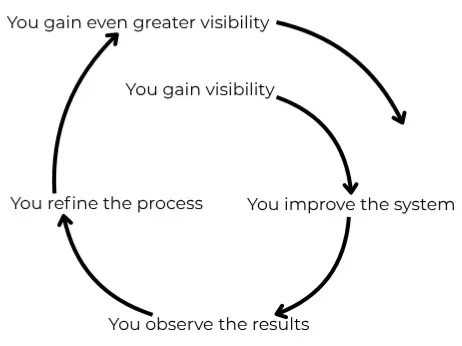
Over time, this cycle creates a business that becomes less dependent on the owner and more capable of operating consistently.
That’s how control is built.
Not through working harder.
Through working smarter.
Why Control Creates More Than Time
Most people think control is about getting their evenings back.
That’s certainly one benefit.
But control creates much more than free time.
It creates capacity.
Capacity to think strategically.
Capacity to develop new products.
Capacity to invest in your team.
Capacity to improve customer service.
Capacity to enjoy your business again.
It also affects the other two motivators within The Thriving Blueprint.
Greater control often leads to healthier cashflow because you’re spending more time improving the business instead of constantly reacting to it.
It also increases confidence.
When your business is organised and running well, you make decisions with greater clarity.
You stop feeling like you’re constantly behind.
You begin leading the business instead of simply keeping up with it.
Helen’s Insight
One of the biggest misconceptions I hear is,
“I’ll work on systems when things quieten down.”
The reality is usually the opposite.
Things become quieter because you’ve worked on your systems.
Waiting until you have more time often means waiting forever.
Sometimes the busiest businesses need systems the most.
Control Is Built One Decision at a Time
You don’t need to redesign your entire business this week.
In fact, trying to change everything at once often creates even more overwhelm.
Instead, start small.
Document one process.
Delegate one responsibility.
Review one recurring problem.
Schedule one hour each week to work on your business.
Small decisions may not seem significant today.
But over time they change the way your business operates.
The same way small habits gradually caused you to lose control, new habits can gradually help you regain it.
That’s how thriving businesses are built.
Not through one massive breakthrough.
Through hundreds of intentional improvements.
Looking Ahead
Understanding the Three Drivers is only the beginning.
The next step is turning these ideas into daily habits.
In the final section, we’ll explore the practical habits that help business owners maintain control, reduce stress and create a business that supports the life they actually want.
Seven Habits That Help You Stay in Control
Taking back control doesn’t happen because you have one exceptionally productive week.
It happens because you build habits that make your business less dependent on you over time.
The most successful business owners I’ve worked with don’t necessarily work harder than everyone else.
In fact, many work fewer hours.
The difference is that they’ve developed habits that allow them to spend their time where it creates the greatest value.
Here are seven habits that can help you design a business that supports your life—not consumes it.
Habit 1 – Schedule Time to Work On Your Business
One of the easiest habits to overlook is also one of the most valuable.
Most business owners spend almost every day working in their business.
- Serving customers.
- Managing staff.
- Answering emails.
- Solving problems.
Those activities are important.
But if they’re all you ever do, your business will remain exactly as it is today.
Every week, schedule time to work on your business.
Use that time to:
- review performance
- improve systems
- identify bottlenecks
- plan ahead
- make strategic decisions
Protect this time just as you would an important client appointment.
Because it is.
It’s an appointment with the future of your business.
Habit 2 – Review Your Numbers Regularly
Control isn’t just about time.
It’s also about understanding what’s happening inside your business.
Successful business owners don’t wait until the end of the financial year to review their numbers.
They look at them consistently because good decisions begin with good information.
You don’t need to spend hours analysing reports.
Simply ask yourself questions like:
- Is our cashflow healthy?
- Are sales tracking to plan?
- Which services are performing well?
- Are expenses increasing?
- What trends are emerging?
- Where are we spending time that isn’t creating value?
Your numbers tell a story.
The more often you read that story, the easier it becomes to make confident decisions.
Habit 3 – Improve and Document One Process Every Month
Business improvement doesn’t have to be complicated.
Choose one recurring task each month and ask:
“How could this be easier?”
Perhaps it’s:
- onboarding new customers
- invoicing
- answering enquiries
- staff training
- scheduling appointments
Small improvements accumulate surprisingly quickly.
After twelve months you’ve improved twelve important parts of your business.
Progress beats perfection.
Helen’s Insight
One of the biggest mistakes I see is business owners believing they need to change everything at once.
You don’t.
Some of the biggest improvements I’ve seen have come from one small change made consistently.
Improve one process.
Review your numbers.
Learn from what they’re telling you.
Then improve the next process.
Small improvements might not feel significant today, but over time they transform the way your business operates.
That’s how thriving businesses are built—not through one massive breakthrough, but through hundreds of intentional improvements.
The more knowledge you move into documented systems, the more freedom you create for yourself and your team.
Habit 4 – Delegate With Purpose
Delegation isn’t simply about removing work from your desk.
It’s about giving other people the opportunity to contribute.
When you delegate effectively:
- your team develops confidence
- customers receive faster service
- decisions happen more quickly
- you create time for higher-value work
Start by identifying tasks that someone else could do just as well—or perhaps even better.
Remember, your goal isn’t to stay indispensable.
It’s to become increasingly valuable.
Habit 5 – Protect Your Thinking Time
Some of your most valuable work happens away from your inbox.
Constant interruptions make it difficult to think clearly.
Set aside uninterrupted time each week to focus on:
- strategy
- planning
- problem-solving
- innovation
- reviewing opportunities
The quality of your decisions often depends on the quality of your thinking.
Protecting that time is an investment in your business.
Habit 6 – Learn to Say No
Every opportunity has a cost.
When you say yes to one thing, you’re saying no to something else.
Successful business owners become very clear about what aligns with their goals.
Not every customer is the right customer.
Not every opportunity is worth pursuing.
Not every task deserves your attention.
Learning to say no isn’t about being difficult.
It’s about protecting the time and energy required to say yes to the things that matter most.
Habit 7 – Make Reflection Part of Your Routine
Many businesses are so busy moving forward that they never stop to learn from where they’ve been.
At the end of each week, ask yourself:
- What worked well?
- What created frustration?
- What could be simplified?
- What should I stop doing?
- What should I start doing?
Reflection creates awareness.
Awareness creates improvement.
Improvement creates control.
Helen’s Insight
When I first meet many business owners, they usually tell me they need to work harder.
A few months later, they often tell me something very different.
They’ve realised they didn’t need to do more.
They needed a business that asked less of them.
That’s one of the most rewarding transformations I see.
Because the goal isn’t simply to create more free time.
It’s to create a business that gives you the freedom to focus on the work that only you can do.
That’s when business ownership becomes enjoyable again.
Bringing It All Together
Taking control of your business isn’t about finding the perfect productivity app or squeezing more hours into your day.
It’s about building a business that works well because you’ve designed it to.
When you develop better habits…
When you improve your systems…
When you create space to think…
You begin shifting from reacting to leading.
That shift changes more than your calendar.
It changes your experience of running a business.
Instead of constantly feeling overwhelmed, you begin making decisions with greater clarity.
Instead of working longer hours, you start creating better ways of working.
Instead of feeling trapped by your business, you begin experiencing the freedom that inspired you to start it in the first place.
That’s what Control looks like.
And that’s why it’s one of the three motivators within The Thriving Blueprint.
Because when you gain Control, you create the capacity to improve your Cash, strengthen your Confidence and create a business that truly supports the life you want.
The Thriving Business Checklist
Before you move on, take a moment to reflect on your business today.
How many of these statements can you honestly answer “Yes” to?
- I can take a holiday without my business coming to a standstill.
- My team can make routine decisions without asking me.
- We have documented systems for our most common tasks.
- I spend dedicated time each week working on my business.
- I regularly review my numbers and key business metrics.
- I know where my time creates the greatest value.
- My business can continue operating effectively when I’m not there.
If you answered “No” to several of these questions, don’t be discouraged.
Every thriving business started somewhere.
The important thing is recognising where you are today and taking the first step towards where you want to be tomorrow.
Frequently Asked Questions
How do I take control of my business when I’m already overwhelmed?
Start with one change rather than trying to fix everything at once. Identify the biggest drain on your time and improve that first. Small, consistent improvements are far more sustainable than trying to transform your entire business overnight.
What’s the difference between working in my business and working on my business?
Working in your business is delivering products or services and managing day-to-day operations. Working on your business involves improving systems, planning for growth, reviewing performance and making strategic decisions. Both are important, but businesses only improve when time is intentionally set aside to work on them.
How much time should I spend working on my business?
There’s no single answer, but even one dedicated hour each week can have a significant impact. The important thing is consistency. Protect that time as you would any important client meeting.
Can I regain control without hiring more staff?
Yes. While additional team members can help, many control issues stem from unclear systems, unnecessary complexity or poor delegation rather than a lack of people. Improving processes often creates capacity before additional staff are needed.
Why do I still feel busy even when business is going well?
Being busy and being productive are not the same thing. Many business owners spend their days reacting to immediate demands instead of focusing on activities that move the business forward. Regaining control starts with understanding where your time is really going.
Your Next Step
If this guide has helped you recognise that your business has become too dependent on you, the next step is to understand where you are today.
Take the Business Health Quiz to discover whether your business is currently Struggling, Surviving, Living or Thriving, and identify the changes that will have the greatest impact on your Cash, Control and Confidence.
If you’re ready to develop a business that gives you more freedom—not more stress—explore The Thriving Blueprint Course. You’ll learn practical strategies to improve your systems, strengthen your financial foundations and develop the habits that help business owners lead with confidence.
Remember, taking control isn’t about doing everything yourself.
It’s about creating a business that can thrive because you’ve built it intentionally.
Continue Reading
Continue your journey with these related articles:
Thriving Blueprint
- The Thriving Blueprint: A Framework for Business Growth
- The 3 Motivators Every Business Owner Needs
- The 3 Drivers of a Thriving Business
- The Four Stages Every Business Owner Experiences | From Struggling to Thriving
Cashflow & Profit